Yellow jackets are the reason most White Marsh calls come in during late August and September. Colonies that started small in May peak with thousands of workers by the end of summer, and the ones nesting underground…
Yellow jackets are the reason most White Marsh calls come in during late August and September. Colonies that started small in May peak with thousands of workers by the end of summer, and the ones nesting underground find the same spots every year: mulch beds against retaining walls in Nottingham Ridge, voids under front-step slabs in Cowenton, chipmunk burrows along the woodline edges near Honeygo Run Regional Park and the Days Cove side of Gunpowder Falls State Park. Ground nests give away their location if you stand back ten feet and watch one point in the lawn for thirty seconds — steady traffic in and out of a single hole. That hole is where the treatment goes. Spraying the air above it accomplishes nothing.
The vinyl-sided townhomes and newer builds off Route 43 — Greenleigh, Honeygo Village, The Vineyards of White Marsh — bring a second pattern: wasps and yellow jackets slipping behind J-channel, soffit returns and unsealed light fixtures, then building inside the wall or the box gutter return. On a shared-wall home this matters, because a colony that enters at your neighbor's downspout can be nesting above your bedroom ceiling. We trace where insects actually disappear into the structure before treating, then treat the void through that entry rather than blasting the visible siding. We do not fog an attic or a wall cavity blind — that spreads product where nobody wanted it and leaves a live colony behind the drywall.
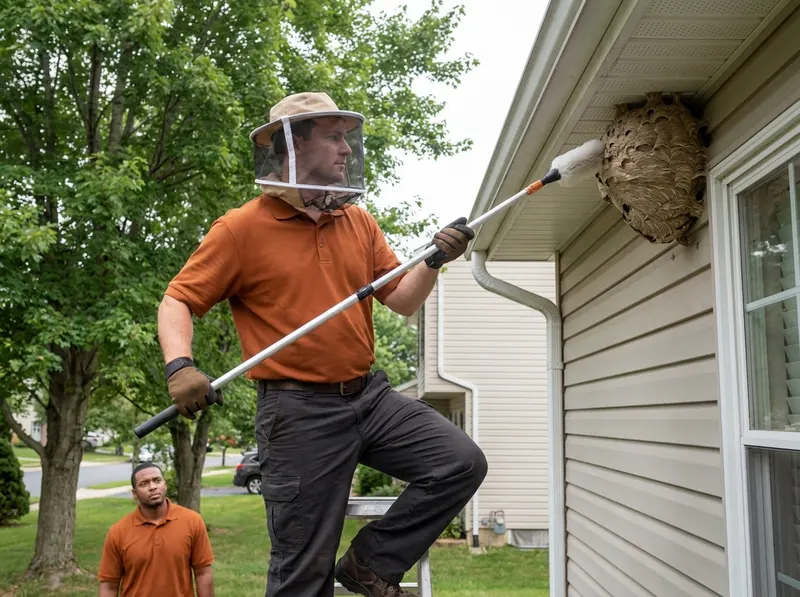
Deciding between removal and treat-in-place is straightforward. If the nest hangs in open air — a paper wasp nest under a Whitemarsh Run deck rail, a hornet nest in an ornamental tree near a driveway — it gets treated and then physically taken down, so nobody is looking at a nest all fall and so a returning queen has no framework to reuse. If the colony is inside a wall, under concrete, in a soffit cavity or behind brick, removing it means opening the structure, and that is a demolition job, not a pest job. In those cases the colony is treated at the entry and left to die off in place; the paper comb dries out and is not re-occupied the following year. The trade-off is honest: treat-in-place costs less and carries no repair risk, but you may see stragglers for several days as returning foragers hit the treated entry.
One more thing worth knowing about the calendar here. Nests die on their own after the first hard frost in Baltimore County, usually November, and the queens overwinter elsewhere — so a hornet nest still hanging in a bare tree in January is empty and harmless. Paper wasps, on the other hand, start scouting sheltered spots in April, which is why the same porch ceiling, grill lid or playset joint near a Vincent Farm Elementary–area cul-de-sac gets a nest year after year. If a spot has produced a nest three springs running, the fix is a spring inspection and a check of the gaps, not a bigger can of spray. Dumpster enclosures and loading areas in the White Marsh Business Community draw scavenging yellow jackets in late summer for the same reason — food source first, nest second.
Allergy situations get scheduled first. If someone in the house carries an epinephrine auto-injector, say so when you call and we prioritize the visit — MedStar Franklin Square Medical Center is minutes away in adjacent Rosedale, but the point is to not need it.
Every job gets a firm, written price after a free on-site visit.
Tell us about your wasp, hornet and yellow jacket nest removal job in White Marsh and we'll send a clear, written quote — usually the same day.
 Orvexa Bug Solutions