Odorous house ants are the ant most White Marsh homeowners are actually looking at. They are small, dark brown, move in a steady line along a counter edge or grout seam, and give off a sharp rotten-coconut odor when…
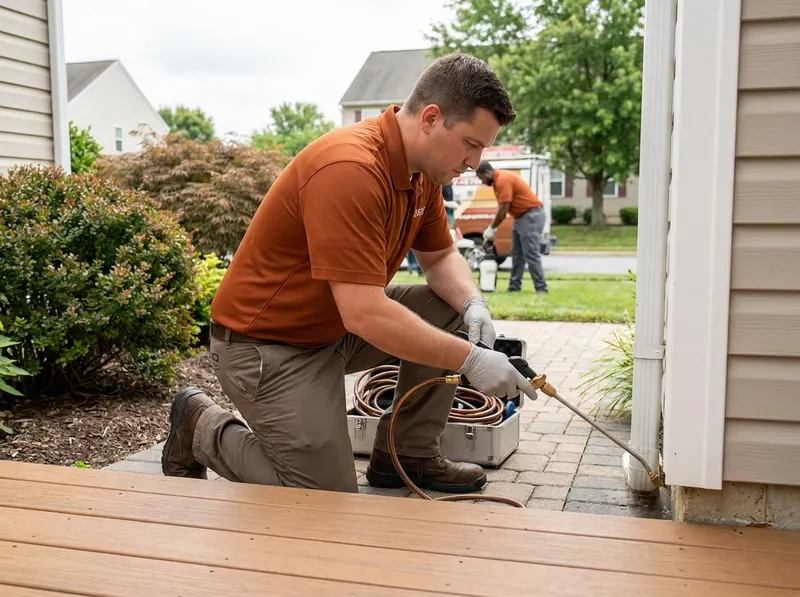
Odorous house ants are the ant most White Marsh homeowners are actually looking at. They are small, dark brown, move in a steady line along a counter edge or grout seam, and give off a sharp rotten-coconut odor when crushed. Their colonies carry many queens and nest in warm, protected voids — under slabs, behind bath tile, inside wall voids near a leaking shower valve, and outdoors under mulch, landscape stone, and sidewalk expansion joints. That multi-queen structure is why a hardware-store spray backfires: the colony reads the repellent as a threat and buds into satellite nests, so the one trail in the kitchen becomes trails in the bathroom and the laundry room. We do not spray repellent products on interior ant trails. Non-repellent bait and gel go where the foragers already travel, and the ants distribute it for us.
Carpenter ants are a different job. They are much larger, mostly black, often seen alone rather than in a line, and they are most active after dusk — which is why the first sighting is usually a big ant crossing a hallway floor at 10pm. Carpenter ants do not eat wood; they excavate galleries in wood that is already damp, and they push out frass that looks like coarse sawdust mixed with insect parts. In White Marsh that moisture usually traces to a specific, findable defect: a deck ledger board, a window header under failed caulk, a chimney flashing seam, a slow supply line under a kitchen sink, or an AC condensate line dumping against sheathing. Homes backing the wet woods along Honeygo Run, the tree line at Honeygo Run Regional Park, and the Gunpowder Falls corridor near Days Cove sit next to large outdoor carpenter ant reservoirs, so parent colonies commonly live in a stump or standing dead limb outside while a satellite nest sets up in the house. Treating the satellite nest without correcting the moisture source only buys a season.
Structure matters more than address. In the Route 43 townhome developments — Greenleigh, Honeygo Village, Nottingham Ridge, The Vineyards of White Marsh — shared walls and continuous slabs let odorous house ants move between units, so treatment concentrates on the shared-wall side, the slab-to-plate line, and the exterior mulch bed both units share. Older Cowenton and Whitemarsh Run properties with crawlspaces and mature trees skew toward carpenter ants and need the sill plate and band joist inspected with a light and a probe, not just a perimeter spray. Break rooms and dumpster pads in the White Marsh Business Community draw sugar-feeding odorous house ants year after year and are handled as a sanitation-plus-bait problem.
Here is the honest trade-off. Bait is slower to look impressive than a spray — you may see more ants for a day or two as foragers recruit to the bait — but it reaches queens a spray never touches. A contact spray gives you an empty counter tonight and a bigger colony next month. If you want the trail gone permanently, bait is the right call. If a carpenter ant nest is inside a wall, void injection at the gallery plus fixing the leak is the right call, and we will tell you which of the two you are dealing with before quoting. Peak ant calls here run spring through early summer, when swarms and mulch refreshes get colonies moving; interior activity in January usually means the nest is already inside the structure and warrants a closer look.
Every job gets a firm, written price after a free on-site visit.
Tell us about your ant control for odorous house ants and carpenter ants job in White Marsh and we'll send a clear, written quote — usually the same day.
 Orvexa Bug Solutions