Stink bugs do not breed inside your house. They enter through a gap, sit dormant in a wall void or attic bay all winter, and then reappear at your bedroom window in February when the sun warms that wall. That single…
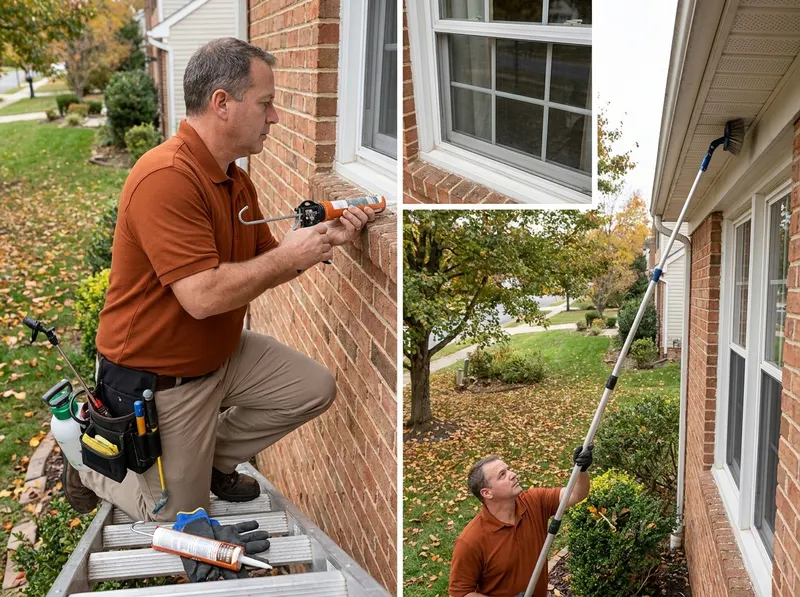
Stink bugs do not breed inside your house. They enter through a gap, sit dormant in a wall void or attic bay all winter, and then reappear at your bedroom window in February when the sun warms that wall. That single fact decides the whole strategy: sealing in early fall keeps hundreds out, while spraying baseboards in January only kills the few that already found their way to the living side of the drywall. On the Route 43 townhomes in Greenleigh and Honeygo Village, the usual entry points are the vinyl siding J-channel and the gap where the siding meets the roofline of an attached unit — which is also why a neighbor's unsealed end wall can keep feeding your top floor no matter what you do inside. Older Cowenton and Nottingham Ridge houses tend to leak at wood-framed attic vents and around window trim that has pulled away from the sheathing.
Spotted lanternfly is a different problem and we describe it honestly. Adults are not true overwintering invaders — they die off with hard frost, and the fall issue is nuisance clustering on siding, decks, patio furniture and railings, plus gray, putty-like egg masses of roughly 30 to 50 eggs stuck to trunks, fence posts, grills and wheel wells. Baltimore County sits inside the range where spotted lanternfly is established, and the density tracks tree of heaven along the stream corridors — the Whitemarsh Run edges, the wooded margins near Honeygo Run Regional Park, and the Gunpowder Falls State Park land out toward Days Cove and Sweathouse Branch. Homes in The Vineyards of White Marsh and along the wooded rear lots of Honeygo Run see the heaviest late-summer landings. Scraping egg masses in fall and winter is the highest-value thing a homeowner can do, and we show you what to look for so you can keep doing it after we leave.
Exclusion fits when your complaint is seasonal and structural: stink bugs on the same three windows every year, insects dropping from a bathroom exhaust fan, clusters on the sunniest gable. The alternative — interior treatment after they are already inside — fits when you missed the window and need relief now, but the trade-off is real. Once insects are behind drywall we can vacuum, treat accessible voids and reduce what reaches your rooms, but we cannot remove what is sealed in the wall, and every warm February afternoon will release a few more. That is scope honesty, not a hedge. We also do not blind-fog attics or crawlspaces for overwintering pests, because fogging leaves the gaps open and the bugs return the following September.
A visit takes one to three hours for a typical White Marsh townhome or single-family home. We count and photograph entry points, tell you which ones we can close that day and which need a contractor (rotted trim, failed roof flashing, missing crawlspace door), and treat the exterior surfaces where the insects stage. Small commercial suites in the White Marsh Business Community and the office and retail buildings near the Mall and The Avenue get the same approach, usually focused on rooftop units, loading-dock frames and light-attracting glass. Every price we give before the on-site visit is a ballpark — the exact number is confirmed in writing after we have walked the building. Call (667) 310-2756 and tell us which windows they show up on; that detail usually tells us which elevation is leaking.
Every job gets a firm, written price after a free on-site visit.
Tell us about your stink bug and lanternfly fall exclusion job in White Marsh and we'll send a clear, written quote — usually the same day.
 Orvexa Bug Solutions